
3D Product Rendering vs AI: Why Brands Using AI Risk Losing Customer Trust
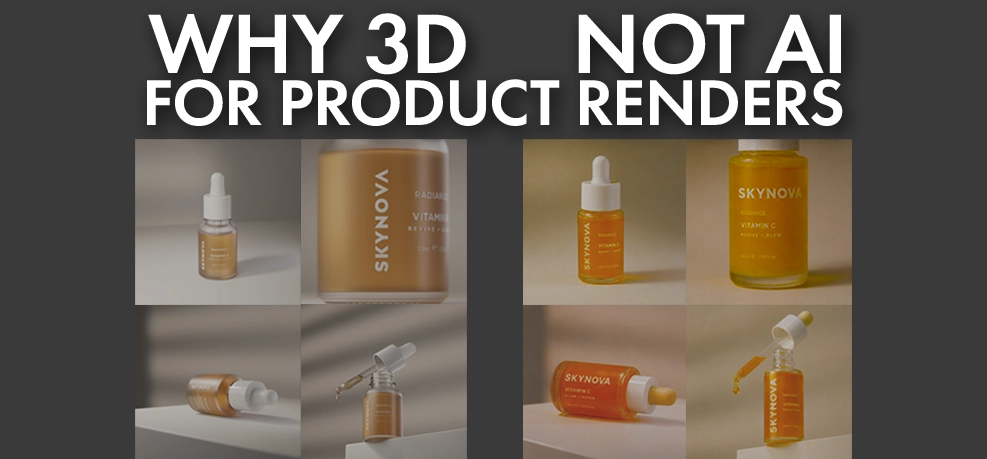
When brands choose between 3D product rendering and gen-AI, the risk is not just how good the ad looks. It is whether customers believe what they see. An ad came up on Instagram recently, for a well-known Indian appliance brand. The product visual itself looked good: cleanly lit, sitting realistically in its own shadow, holding prominence in the frame - as it should. At first glance, that product shot looked like a 3D render. As the ad played, I began to suspect that generative AI had replaced some of the 3D work. I cannot be certain how it was made. What caught my attention was the scene around the product.
Elements of the scene drifted through the shot in positions that nothing could possibly occupy. They moved without weight. One of them changed into something else halfway through its own travel; and through it all, the ad carried on as though nothing had happened.
In my mind, I said: Wait… what just happened? I thought I was looking at a representation of the product. Now I was wondering which parts of the image I could trust.
The interesting part is not that the gen-AI visuals looked bad. Some of it looked rather good. The interesting part is that the ad stopped being believable anyway; and that’s something that can become very expensive for a brand.
The AI-tell was not ugliness
The failure mode of generative AI video is not poor quality anymore - we’re past that threshold. It is content drift. A shape changes between frames, an object does things it can’t in reality, and that no human would make it do. An object moves as though it has no mass. A surface that was brushed metal a moment ago is now something closer to plastic, and nothing in the video accounts for the change.
Most viewers will not really think about any of this. Nobody watching an appliance ad is consciously thinking about the temporal coherence of the objects in the video ad. Viewers simply feel that something is off, and they stop extending the video ad the benefit of trust. They sense that something about the brand is no longer trustworthy.
That doubt escalates. Once one element in a shot reads as fabricated, everything sharing the frame inherits the suspicion, including the elements that were true. The product itself still looked convincing. I could not tell whether it came from a 3D render, or generative AI. But the scene around it had already made me doubt what I was seeing. The product was keeping bad company in the frame, and that changed my perception of the product, and of the company.
Since then I’ve spoken to a few people around me about this, and they’ve had similar experiences… AI ads simply cannot carry the trust that a brand needs. They feel the same for AI reels - but I digress. Let’s get back to the topic at hand.
A 3D model is a reference point. An AI prompt is not.
On the flip side, a 3D model is a fixed reference point, while an AI prompt can be interpreted multiple ways.
The 3D model is built once, to measurement, with nothing left to interpretation. Every frame that’s rendered from 3D is the same as a camera looking at that same object in real life. The 3D model cannot drift between shots because nothing re-decides it between shots. Move the camera, change the (virtual 3D) lens, relight the scene, cut to a close-up of the control panel, and the geometry underneath is the same geometry it was in the wide shot.
Generative AI tools do not work this way. Each frame is produced afresh. Reference images, seeds and conditioning all narrow the variation, yes. In truth these options have narrowed variations a great deal in the last few years, but they do not eliminate it, because what is being asked for is a new image resembling the previous one rather than the same object being seen again.
That sounds like a technical distinction but really, it is a practical one. 3D product rendering can promise you the same object every time. Generation, as it currently stands, can promise you something close … but not the same. When your product changes from frame to frame, how can your clients trust you?
In Advertising, the Product Visual is Everything
In product advertising the product is not decoration. The product’s visual is the promise being made. It is EVERYTHING!
The number of vents on the guard. The proportion of the base to the column. Where the badge sits and how big it is. The exact colourway, which the marketing team spent a month choosing, and that the production factory spent even longer matching in the actual product… These are not details a viewer consciously audits, yet it is all-important. These details are the very thing being sold, and somebody is deciding whether to spend money on the strength of that image that they see.
Generative tools have no concept of this particular product. They have a concept of an appliance roughly like this one. Ask for another angle and you will get something plausible, and plausible is precisely the problem: whatever it invents becomes a claim your brand did not make, cannot stand behind, and is showing to somebody at the moment they are deciding to buy. The same logic applies to what goes on the pack, where the gap between the image and the object in the customer’s hand is even shorter. It better match!
Where Generative AI earns its place in all of this
None of this is an argument against the tools. I use them.
Generative AI can be genuinely good at the parts of the process where the product doesn’t matter. Gen-AI could be great at Ideation, Mood boards, Look development, Quick roughs that let a client react to a direction before anyone commits real hours to it, Environments and abstract backgrounds that exist to hold a mood rather than to describe a thing you can buy. Used there, they save days and costs the brand no loss of reputation.
The line I work to is straightforward. Use AI where nothing is on the line. I use 3D rendering where the product is shown. That is close to the distinction I drew about writing in an AI world: the tools are useful right up to the point where the output has to carry the brand’s promise.
3D Product Rendering Leaves You an Asset You Keep
The 3D model is an asset that remains with the brand for all time!
A 3D model is something a brand can own, lock down and change as the product itself changes. The same asset is used across the video, the listing images, the carton mock-up, the buyer’s deck and next year’s festive variant, and it does all of that at whatever size the supermarket shelf happens to be. Build it once in 3D, and you can render images from the 3D model for years…
The working relationship is different too. A 3D model takes direction: rotate it fifteen degrees, drop the key light, make the cap matte, show me the version with the second colourway. Those are instructions with predictable, and reliable outcomes. On the other hand, Gen-AI takes re-rolls of the generative dice, where you regenerate and hope, and the detail you liked last time may not survive the dice’s cast.
What we owe the customer: reliability and trust
Underneath all this discussion lies something simple. People extend a certain trust to brands they recognise. A brand’s trust takes years and a great deal of money to build, and an ad showing a product that does not exist exactly the way it was advertised breaks that trust instantly. And why? Just to save some money, and maybe a few days of production time. This is not the action of a trustworthy brand.
The audience that is able to spot these shortcuts is growing, not shrinking. Every month more people learn the AI-tells, because more people are using the tools themselves. What passes as a clever shortcut or money saving device this year will read, fairly soon, as a brand that could not be bothered to show you the actual thing - a brand that loses its buyers’ trust.
Customers deserve to be able to trust what they are looking at. Brands they already know should be the last ones to make them question what they’re being shown.
Are you launching a new product and want it to look like itself? Let’s talk →
Working on something like this?
Tell me about the product, how many images you need and where they will be used. I'll tell you whether 3D, photography or a mix of both makes sense.
3D Visualisation: how the service works →