
3D Rendering for Packaging Design: See Your Product Before It Exists
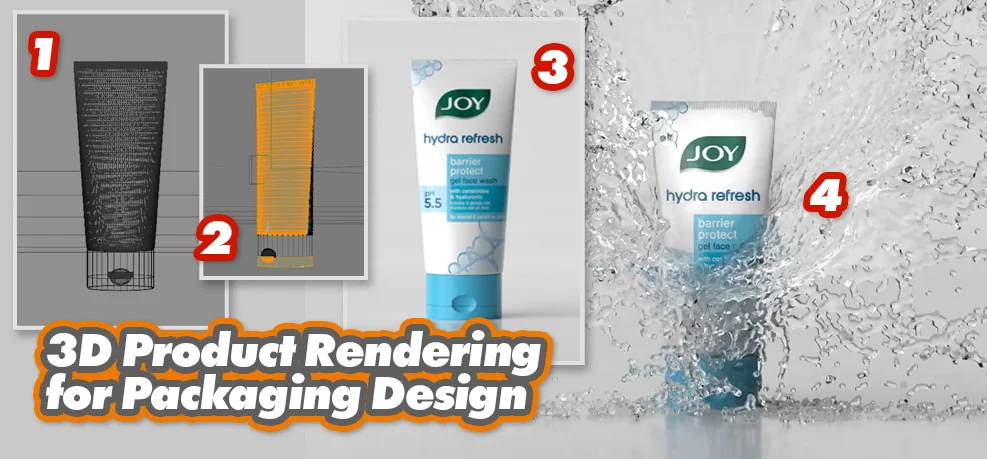
When you’re an MSME, designing packaging for your product can be frustrating. Imagining what your final product will look like next to competitors on shelves, or in the customer’s hands can be tricky. What if the sizes aren’t right? What if the colours don’t stand out enough? What if the product sticks out like a sore thumb, to be avoided! Waiting to see the product on shelves means waiting for too long, and if something feels off at that stage, changes are expensive and slow - time and money that you just don’t have.
3D Rendering and visualisation lets you see your packaging: photorealistic, fully rendered, in the exact form factor it will eventually take ... long before anything is manufactured. You can rotate it, light it, place it on a shelf, put it in a lifestyle setting. All from a design file! This saves time and money for MSMEs that want to get to market quickly, effectively, and with least wastage.
Hi! I’m Nabina, and I work across both packaging design and 3D rendering, which means I see both sides of this process daily. Since I handle both aspects in-house, it changes how things come together. I will come back to why that matters later in this piece.
But first, let me walk you through: a) what the 3D rendering process actually involves for product packaging, b) when it makes sense, and c) what you can do with the output once you have it.
What 3D Packaging Rendering Actually Involves
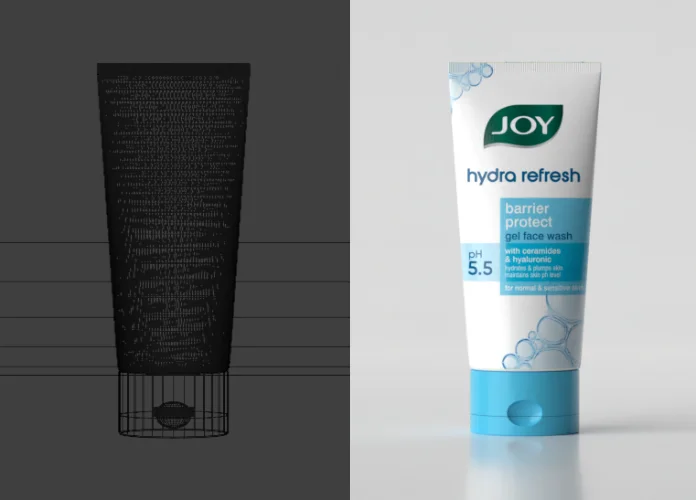
The starting point is usually a packaging design. This could be a structural die-line, label artwork, or a complete packaging layout. From there, a 3D model of the packaging form is built, whether that is a bottle, carton, sachet, jar, or pouch. The artwork is then mapped onto the model, carefully following the contours and curves of the shape. Materials are assigned (matte paper, glossy laminate, metallic foil, transparent plastic), lighting is set up, and an environment is created around the product.
The result is a render that looks like a photograph, but no physical product exists. There is no studio, no camera, no printed packaging. Everything you see has been constructed digitally.
The range of packaging forms this covers is broad: rigid boxes, folding cartons, bottles and jars of every shape, flexible pouches and sachets, tubes, blister packs, labels on containers, shrink sleeves, and more. If it can be designed, it can be rendered.
When Brands Use 3D Visualisation, and Why
The most common question I get from clients new to 3D rendering is straightforward: when does this actually make sense? There are several scenarios where it solves real problems.
3D Rendering Before Manufacturing
This is perhaps the most valuable application, and the one that often surprises people. A packaging design that looks balanced on a flat screen can behave quite differently when wrapped around a curved bottle or folded into a box. Colours shift. Typography that felt well-proportioned on a flat layout can feel cramped on a smaller panel or lost on a larger one. Hierarchy changes when you move from two dimensions to three.
3D renders let you catch all of this before a single unit is produced. You are not just checking the design, you are studying it. Evaluating proportions, testing how the eye moves across a surface, seeing whether that metallic finish actually does what you hoped it would. This is 3D being used not as a consumer-facing visual, but as a decision-making tool for the brand itself. It is a way to understand your own product better, to explore its possibilities with clarity and without the cost of physical samples.
Variant Exploration with 3D
If you are launching a product line with multiple flavours, colours, or variants, 3D rendering is enormously efficient. Once the base model exists, generating ten colourways from it is relatively quick. You do not need ten separate prototypes. You do not need ten photo shoots. You simply adjust the artwork on the existing model and render each version.
This is especially useful for FMCG brands extending a product line, where seeing how the full range looks together, on a shelf, in a consistent visual language, matters as much as seeing each variant individually.
Pitches and Investor Decks with 3D Renders
When a product does not physically exist yet, which is the case for most startups and crowdfunding campaigns, 3D renders are often the only way to present a polished product visual. Investors, retail buyers, and crowdfunding backers all respond to seeing a finished-looking product. A render gives you that finished look without needing a finished product.
Retailer Presentations with 3D Mock-ups
Retail buyers want to see how a product looks on a shelf, ideally next to competitors, in the kind of planogram context they are used to evaluating. 3D rendering makes this possible even when the product is months away from production. You can show shelf presence, facings, and visual impact in a way that flat artwork simply cannot communicate.
E-commerce Presence Before Launch, with 3D Renders
Online marketplaces require product listing images. If you are building a pre-launch presence, or need to have listings live the moment stock arrives, 3D renders give you high-quality product images without waiting for actual inventory to photograph.
What You Can Do with 3D Renders
The output from a 3D packaging visualisation project is not a single image. It is a flexible asset that can be used across a wide range of applications. Marketing collateral such as brochures, catalogues, and social media posts. Website product pages. Advertising campaigns, both print and digital. Animated product videos, including turntables, exploded views showing packaging components, and assembly or unboxing sequences. Point-of-sale displays and trade show materials.
When I design the packaging itself and then render it in 3D, the transition from one to the other is seamless. I already have the artwork files and understand the design intent, the colour choices, the finish specifications, the structural details. The rendering is a natural extension of the design process, not a separate brief to be communicated to a separate vendor. If packaging design is something you are considering alongside visualisation, that is a service I offer as well.
3D Renders vs Product Photography for Packaging
This is a question that comes up often, and I have written about it in detail separately. The short version: when the physical product exists and you need images that capture real-world texture, imperfections, and context, photography is often the right choice. When the product does not exist yet, or when you need to show multiple variants, custom environments, or configurations that would be expensive and time-consuming to set up in a studio, 3D rendering is the more practical path.
Photography is primarily a consumer-facing medium. You photograph a product to show it to the people who will buy it. 3D rendering serves that purpose too, but it also serves an internal, strategic purpose: it is a tool for the brand to study, evaluate, and refine its own product before it reaches consumers. That dual utility, both outward-facing and inward-facing, is what makes it particularly powerful at the earlier stages of product development.
For the full comparison, including when to use each approach and what the cost and timeline differences look like, I have covered this in a separate blog post - 3D Rendering vs Photography.
The Advantage of Working with Someone Who Designs and Renders
Most packaging designers hand off their artwork to the client, and the client then separately commissions 3D renders or photography from another vendor. There is nothing wrong with this approach, but it does introduce a gap. The person rendering the packaging has to interpret the design. They need to understand the intended finishes, the hierarchy, the mood the designer was aiming for. Sometimes this translation works perfectly. Sometimes it does not. Why leave this synergy to chance?
When the same person handles both the packaging design and the 3D visualisation, that gap disappears. Colours are exact. Material finishes are accurate because they were part of the original design thinking, not communicated through a brief. Structural details are faithful because the person building the 3D model is the same person who designed the dieline.
It is a simpler process with fewer handoffs, fewer rounds of revision, and a more cohesive result. If this is an approach that appeals to you, my 3D visualisation and design services are built to work together in exactly this way.
We Develop Product Packaging for Brands! We make the process simple.
If you are in the process of developing product packaging, and want to see it rendered in three dimensions before committing to production, this is something I do regularly for brands across categories. From food and beverage, to personal care, to consumer electronics and beyond...
Whether you are refining a design, preparing a pitch, or building out marketing assets ahead of a launch, 3D visualisation gives you clarity and flexibility at the stage where it matters most. Connect with us at NGCSI to get 3D Visualisation, or 3D Rendering done. We work across India.
Nabina Ghosh Creative Services & Ideas offers 3D Product Rendering and Visualisation as well as Product Design and Packaging Design services. Take a look at the range of creative services we offer.
You can get in touch here to discuss your project.