
How to Brief a Copywriter: A Practical Guide for Clients
A good brief doesn't guarantee good copy. But a bad brief almost guarantees wasted time, revision rounds, and frustration on both sides.
The problem is that most clients have never spent time learning how to brief a creative. They either provide too little — a one-line email with no context — or too much: forty pages of brand documents with no clear direction buried somewhere in the middle.
After over 28 years of receiving briefs from agencies, brands, and startups, patterns emerge. What helps, what doesn't, what's actually essential versus what's noise.
This post covers what to include in a copywriter’s brief, what to leave out, and how to set up the project for success from the start.
The Brief Is Where the Work Begins
A brief isn't a formality. It's the foundation of the entire project.
A copywriter isn't a mind-reader. The brief is how they understand what you're trying to achieve, who you're talking to, and what success looks like to you.
Poor briefs lead to copy that's technically fine but misses the point. They lead to multiple revision rounds that frustrate everyone, delays and budget overruns, and a final product no one's happy with.
Good briefs lead to first drafts that are already close. They mean faster turnaround and a copywriter who's able to push back intelligently if something in the brief doesn't make sense.
The brief is an investment. Time spent here saves time - and money - later.
What Every Copywriter Brief Should Include
1. What is this for?
Start with the deliverable. Is this a website page, a brochure, an ad campaign, an emailer, product descriptions? Be specific about format constraints: word count limits, character limits, number of headlines needed. And clarify where it will appear; context matters enormously.
2. Who is the audience?
Who are we talking to? Be specific.
"Women 25-45" is demographics, not insight. That tells me almost nothing useful.
Better: "First-time founders who've just raised seed funding and need to look credible to enterprise clients." Now I understand who I'm writing for.
Think about what they currently think, feel, or do ... and what you want them to think, feel, or do after reading.
3. What's the single key message?
If the reader remembers only one thing, what should it be? What is the USP?
Force yourself to choose. "We want to communicate A, B, C, and D" means nothing gets communicated clearly. When everything is important, nothing is.
This is hard. It's also the most important part of the brief.
4. What's the desired action?
What should the reader do after reading? What is the CTA of the communication?
Call, click, buy, enquire, remember, share? Be specific. "Visit the website" and "Request a demo" are different briefs entirely; they require different tones, different urgency, different framing.
5. Tone and voice guidance
How should this sound? Professional, warm, playful, authoritative, urgent?
Examples help more than adjectives. "Like Apple" or "like how our CEO talks" gives me something concrete to work with. If brand guidelines exist, share them. If they don't, your input on tone becomes even more valuable.
6. Mandatory inclusions
Flag legal requirements, compliance language, or specific claims that must appear. Taglines, URLs, phone numbers, CTAs that are non-negotiable. Better to know these upfront than discover them during revision.
And here's one that's often forgotten: which languages will this appear in?
I've lost count of how many times I've been asked for "punchy headlines with puns," delivered exactly that, and then received a call saying: "The translators are saying your lines can't be translated. What now?"
A proper brief would have mentioned the need for headlines that resonate regardless of which language they're read in. Now I always ask which languages the output will appear in. I also ask which regions the campaign will run in ... even if it's only in one language. Because cultural associations are as region-specific as puns are language-specific.
7. What does success look like?
How will you judge if this worked? Conversions? Brand awareness? Awards? Internal stakeholder approval?
This helps the copywriter understand what you're actually optimising for. "Make the CEO happy" is a different brief from "increase demo requests by 20%."
What Doesn't Help (and Can Actually Hurt)
- Company history (unless relevant). Copywriters need to understand what you do now, not your complete origin story. The exception: if the history IS the story — heritage brands, founder narratives, anniversary campaigns.
- Competitor analysis overload. Useful: "Here are three competitors, and here's how we're different." Not useful: a 40-page competitive audit with no synthesis or clear takeaway.
- Design direction (usually). Unless copy needs to fit specific visual layouts, design is a separate conversation. Share mockups if they exist, but don't brief design in a copy brief.
- Internal politics. "The CEO likes formal language but the marketing head prefers casual" puts the copywriter in an impossible position. Resolve this before briefing, or at minimum flag that multiple stakeholders will review so the copywriter knows what they're walking into.
- Too many examples. Two or three examples of tone you like: helpful. Fifteen examples: overwhelming and often contradictory.
- Vague adjectives without examples. "Make it punchy" means different things to different people. "Punchy like this headline" is actionable.
How to Actually Deliver the Brief
Written brief (recommended)
Writing forces clarity before the project starts. It creates a reference document everyone can point to when questions arise later. It doesn't need to be formal. A clear, well-structured email works fine.
Verbal brief with written follow-up
Fine for simple projects or ongoing relationships where there's already shared context. But always confirm in writing afterwards. "Here's what I understood from our call..." prevents misalignment and gives both parties a chance to correct course before work begins.
Template vs freeform
Templates ensure nothing's forgotten, which is valuable. But don't let the template become a chore. Short, clear answers beat lengthy placeholder text. A one-page brief that's been genuinely thought through is worth more than a ten-page template filled with "TBD."
What about a briefing call?
Often valuable, especially for larger projects or new relationships. But it's not a substitute for a written brief. The best sequence: written brief first, then a call to discuss and clarify. The call builds on the document rather than replacing it.
What Goes Wrong (and How to Avoid It)
Briefing the solution instead of the problem
"Write a tagline about innovation" tells me what you want me to produce. "We're launching a product that solves X, and customers don't know we exist yet" tells me what problem we're solving. Give the copywriter the problem. Let them suggest solutions ... that's what you're paying for.
No single point of contact
Multiple reviewers with different opinions and no tiebreaker means endless revisions. Agree between yourselves on consolidated feedback before sending it to the copywriter. Designate one person who owns the final call.
Briefing too late
"We need this by tomorrow" means you get what's possible, not what's best. Good copy takes time to think, draft, and refine. Rush jobs can be done, but everyone should be clear about the trade-offs.
Changing the brief mid-project
New information surfacing is fine ... that happens. Moving goalposts isn't. If the brief changes substantially, acknowledge that it's effectively a new project, not a "small revision."
Assuming the copywriter knows your business
Even experienced copywriters need context for your specific situation. Don't over-explain, but don't assume familiarity either. A few minutes of background can save hours of misdirected work.
The Worst Brief I Ever Received
I wish I were exaggerating, but this actually happened.
A new client — someone I'd never worked with before, regarding a brand even Google hadn't heard of — called and said: "Kal ek brochure chahiye." Tomorrow I need a brochure. That was the entire brief.
He sounded annoyed and impatient when I asked for details.
Don't be that client.
A Note on Agencies vs Direct Clients
This isn't absolute, but I've noticed a pattern over the years.
Agencies tend to brief better when it comes to low-priced products. The stories behind everyday products make for quick, interesting research ... something an agency handling multiple brands has bandwidth for. By the time the brief reaches the creative, there's enough substance to work with.
Direct clients often brief better for high-priced or complex products. They know their business intimately. There's less lost in translation, less dependence on how invested the account manager is in understanding the full picture.
Neither is universally better. But it's worth being aware of where gaps might appear depending on who's doing the briefing.
A Starting Point
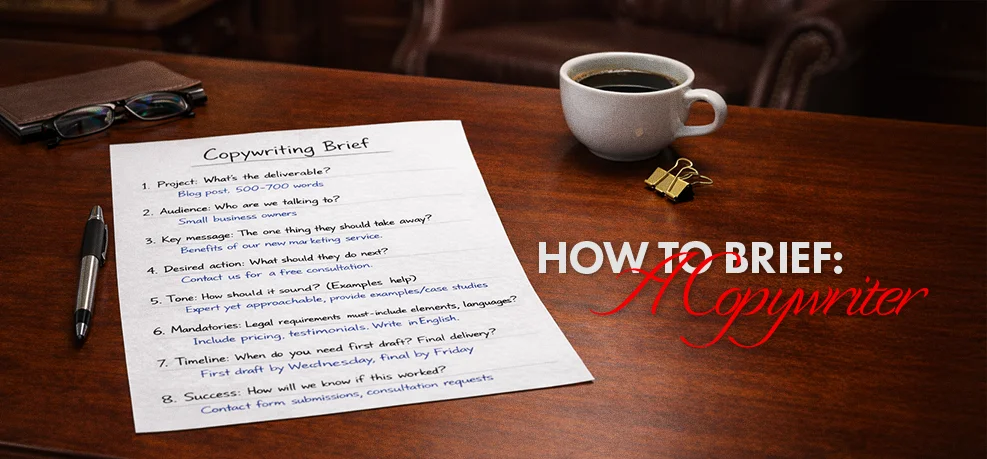
If you're not sure where to begin, answer these eight questions:
- Project: What's the deliverable?
- Audience: Who are we talking to?
- Key message: The one thing they should take away?
- Desired action: What should they do next?
- Tone: How should it sound? (Examples help)
- Mandatories: Legal requirements, must-include elements, languages?
- Timeline: When do you need first draft? Final delivery?
- Success: How will we know if this worked?
This isn't the only format, and rigid templates can sometimes get in the way of genuine understanding. But if you answer these eight questions clearly and honestly, you've done the essential work.
The Brief Is a Collaboration Tool
A good brief respects both parties' time. It gives the copywriter what they need to do their job well, without drowning them in irrelevant information or leaving them to guess at what you actually want.
The better the brief, the faster you get to good work, and the less time everyone spends in revision cycles wondering where things went wrong.
If you're preparing to brief a copywriter and want to discuss your project before putting pen to paper, I'm happy to help you clarify what you need.